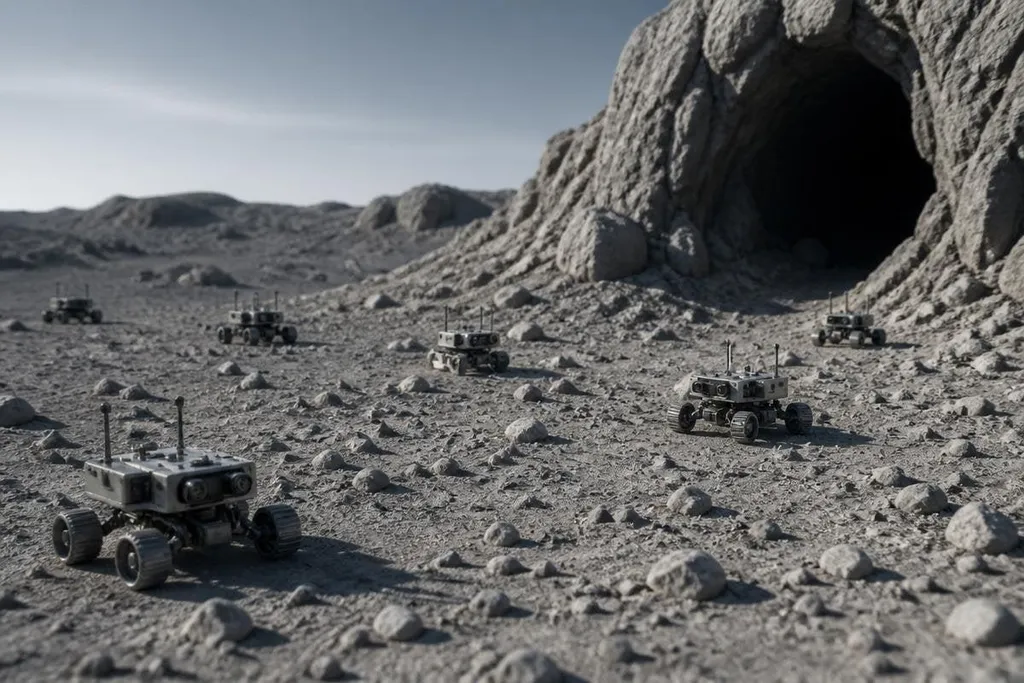
A space swarm could send many small robots to inspect ground, map a cave, or move across loose soil. Its value would come from shared work: each robot handles a small task while the group keeps working when one unit stops.
This article looks at the design questions behind that idea. No mission record, price, flight result, or named program was supplied, so the focus stays on how a swarm would need to work and where the plan could fail.
- Small robots can split a large task
- Local decisions can reduce radio traffic
- Power, heat, and recovery remain open problems
What makes a swarm different
A group of robots needs rules for sharing space, tasks, and sensor data. Each unit would need local sensors to detect nearby robots, terrain, and hazards, then send short status updates to the rest of the group or to a central computer.
That computer should not need to direct every wheel turn. A robot could receive a goal, such as mapping one section, then choose a safe path from the data around it. This approach reduces the number of commands sent from Earth, where long signal delays can make direct control slow.
The group also needs a way to divide work. Robots could mark areas as checked, pass a task to a nearby unit, or leave a damaged unit’s assignment open until another robot reaches it.
Those rules matter more than the word “swarm.” Without them, the group is a set of small machines that may block one another.
Where the machines could work
A swarm makes most sense when the area is too large, rough, or risky for one robot. A group could inspect a wide landing area, map the inside of a cave, or place sensors across ground that changes from one point to the next.
The robot design would depend on the surface. Wheels may work on firm soil, while legs could help with rocks and steep ground. A flying robot could inspect a high wall, but it would need a power budget that supports flight, sensing, and radio contact at the same time.
The task also shapes the sensor pack. Cameras can record surface detail. LiDAR can measure distance and build a map. A temperature sensor can show where equipment or ground differs from nearby areas. Each added sensor uses power and creates more data to store or send.
That trade-off becomes a hardware question once many robots share one mission. Dated space robotics reports from Robot24.com can tie sensor weight and power use to named machines and mission tests before the physical limits take over.
The limits are physical
Radio contact may fail behind a ridge or inside a cave. Dust can cover cameras and joints. Low temperatures can reduce battery output, while heat from electronics has fewer ways to leave a sealed robot in space.
A swarm also needs a recovery plan. One robot could stop moving, lose its map, or send bad data. The remaining robots must spot that change without treating every missed message as a major fault. That calls for clear time limits, repeated checks, and a safe state for each unit.
The group cannot solve every problem through software. A robot with a damaged wheel still needs a route that avoids rough ground. A weak radio link still needs another path for messages. I’d treat recovery after a single failure as the first test, before adding more robots.
What a serious plan must show
A proposal deserves close review when it explains the task, the hardware, and the failure rules in the same document. Use this checklist before accepting a swarm claim:
- Name the task each robot performs and the result that proves it worked.
- Show how units share maps, warnings, and unfinished jobs.
- State the power budget for movement, sensors, computing, and radio contact.
- Test the plan with one robot missing, one sensor giving bad data, and one broken link.
- Set out how people on Earth can pause, redirect, or recover the group.
These points turn a broad space concept into a testable engineering plan. They also show where a single large robot may cost less and work better.
What happens next
The next useful step is a ground test with varied terrain, limited radio contact, and a deliberate robot failure. Until a plan publishes those results, the promise of a space swarm remains a design question, not a flight record.